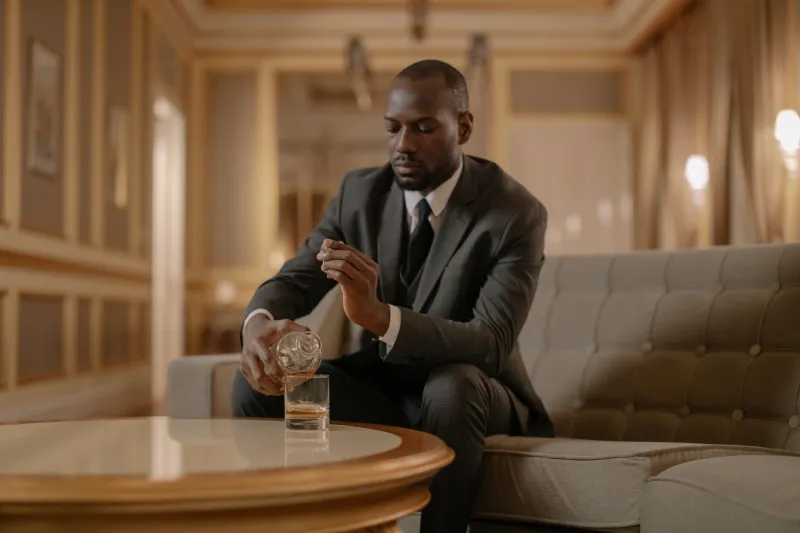
Achieved Everything, Felt Nothing: The Hidden Isolation Driving Elite American Men to Redefine Connection

The Paradox at the Top
There is a particular kind of loneliness that does not announce itself loudly. It does not arrive in empty apartments or quiet Friday evenings. It settles, instead, into the margins of a life that appears, from the outside, to be enviable in every measurable respect—the corner office, the investment portfolio, the social calendar filled with obligations that masquerade as relationships.
For a significant cohort of high-performing American men, this is not a hypothetical scenario. It is a lived reality that researchers have been documenting with increasing urgency over the past decade. The data is striking: according to findings published by the American Psychological Association and echoed in longitudinal studies from institutions including Harvard and the University of Chicago, men in upper-income professional brackets frequently report fewer close confidants, less emotional reciprocity in their relationships, and a deeper sense of social disconnection than their income and status would suggest. The men least likely to admit loneliness, it turns out, are often the most profoundly affected by it.
Understanding why requires examining not just individual psychology, but the structural and cultural conditions that American professional life imposes on its most driven participants.
How Success Becomes a Social Barrier
American professional culture celebrates a particular archetype: the self-sufficient, emotionally restrained, relentlessly productive individual. From business school case studies to corporate leadership frameworks, the implicit message is consistent—vulnerability is a liability, and dependence is weakness. Men who internalize this framework, often from early in their careers, tend to construct lives in which emotional needs are systematically deprioritized in favor of performance metrics.
The consequences are not immediately obvious. In one's twenties and thirties, professional momentum can function as a kind of social substitute—the camaraderie of shared ambition, the identity validation of rapid advancement. But as careers mature and the novelty of achievement fades, many men find themselves surrounded by colleagues, acquaintances, and even romantic partners who relate to them primarily through the lens of their status. Conversations orbit professional accomplishments. Friendships are maintained through transactional favors. Romantic relationships, when they exist, are frequently strained by the same emotional unavailability that made professional success possible in the first place.
Dr. Vivek Murthy, former U.S. Surgeon General, identified loneliness as a public health crisis affecting millions of Americans—and specifically noted that men, and men in high-pressure professions in particular, are among the demographics least equipped by their social conditioning to seek or sustain genuine connection. The architecture of American success, it appears, is not designed with human intimacy in mind.
The Transactional Default
One of the defining features of relationship culture in the United States is its tendency toward transactionalism—a model in which connection is understood implicitly as an exchange of value. This is not always cynical; it is often simply the natural extension of a society organized around market logic. Relationships are evaluated by what they offer: social capital, emotional labor, physical companionship, professional access. When the exchange becomes imbalanced or the utility diminishes, the relationship often dissolves.
For elite men who have spent decades operating within transactional frameworks, this dynamic can feel both familiar and profoundly unsatisfying. They are skilled at navigating exchanges. They are far less practiced at simply being present with another person without an agenda, a performance, or an implicit negotiation occurring beneath the surface.
This is precisely where the conventional American model of companionship—whether romantic, social, or professional—begins to show its limitations. What many high-achieving men describe craving, when pressed to articulate it honestly, is not more transactions. It is the opposite: an encounter characterized by genuine attentiveness, unhurried presence, and a quality of engagement that is not contingent on what they can offer in return.
A Different Model Abroad
It is within this context that the growing interest among accomplished American men in international companionship experiences becomes legible—not as an escape from intimacy, but as a search for a version of it that their domestic environment has consistently failed to provide.
Destinations like Ahmedabad occupy a particular position in this conversation. India's cultural traditions around hospitality, attentiveness, and interpersonal warmth are not superficial customs; they reflect deeply embedded values concerning the importance of making another person feel genuinely seen and welcomed. The companionship culture that has developed in Ahmedabad's premium market draws on these traditions in ways that distinguish it markedly from the transactional models that dominate Western contexts.
Companions operating at the upper tier of Ahmedabad's market are frequently noted by American clients for qualities that go beyond physical presence: intellectual curiosity, emotional perceptiveness, the capacity to engage meaningfully across cultural difference, and an orientation toward the encounter that prioritizes the client's experience of genuine connection over the performance of a role. For men accustomed to relationships defined by what each party extracts from the other, this represents a genuinely disorienting—and often transformative—alternative.
Reframing What Connection Requires
Psychologists who study adult attachment and social bonding have long noted that the preconditions for genuine intimacy are consistent across cultures: a felt sense of safety, the absence of judgment, and the experience of being received as a full human being rather than a functional role. What varies dramatically across cultural contexts is how reliably those preconditions are created—and for whom.
American professional culture, for all its sophistication, has not historically been adept at creating those conditions for its highest achievers. The very qualities that drive success—competitiveness, self-reliance, emotional control—tend to undermine the conditions that intimacy requires. Men who have built identities around those qualities often find that the armor they developed for professional survival becomes an obstacle to personal connection.
What travel to a destination like Ahmedabad can offer—particularly when it includes thoughtfully arranged companionship experiences—is a context in which that armor becomes unnecessary. The cultural distance itself can function as a kind of permission: away from the professional identity, the social surveillance of one's peer network, and the accumulated expectations of long-term relationships, men often report an unusual freedom to simply be present.
A Broader Reckoning
The loneliness epidemic among high-performers is not a niche phenomenon, and the search for genuine connection is not a symptom of failure. It is, increasingly, the logical conclusion of a life lived according to metrics that were never designed to account for human emotional needs.
As more accomplished American men begin to interrogate those metrics—and to travel in search of experiences that offer something the domestic market has not delivered—destinations like Ahmedabad are emerging as unexpected but significant sites of personal reckoning. The companionship industry there is evolving to meet that demand with a level of sophistication, discretion, and genuine attentiveness that many American clients describe as unlike anything they have encountered at home.
For those willing to approach the experience with openness and honesty about what they are actually seeking, the encounter may offer something more valuable than companionship alone: a reorientation toward what connection, at its most authentic, is actually supposed to feel like.